When Konrad Konnerth, Founder and President of Konnexio, arrived in North America after years as a design engineer in Germany, he found himself constantly redesigning and retrofitting machines that were never meant to change. The heavy, single‑purpose systems that served European high‑volume production struggled in a North American market defined by product variation and relentless changeovers. Each upgrade meant weeks on‑site, long shutdowns, and frustrated customers.
“I realized there had to be a better way,” says Konnerth. “These were great workhorses – you set them up for one thing and they would run forever. But changing them was a nightmare.”
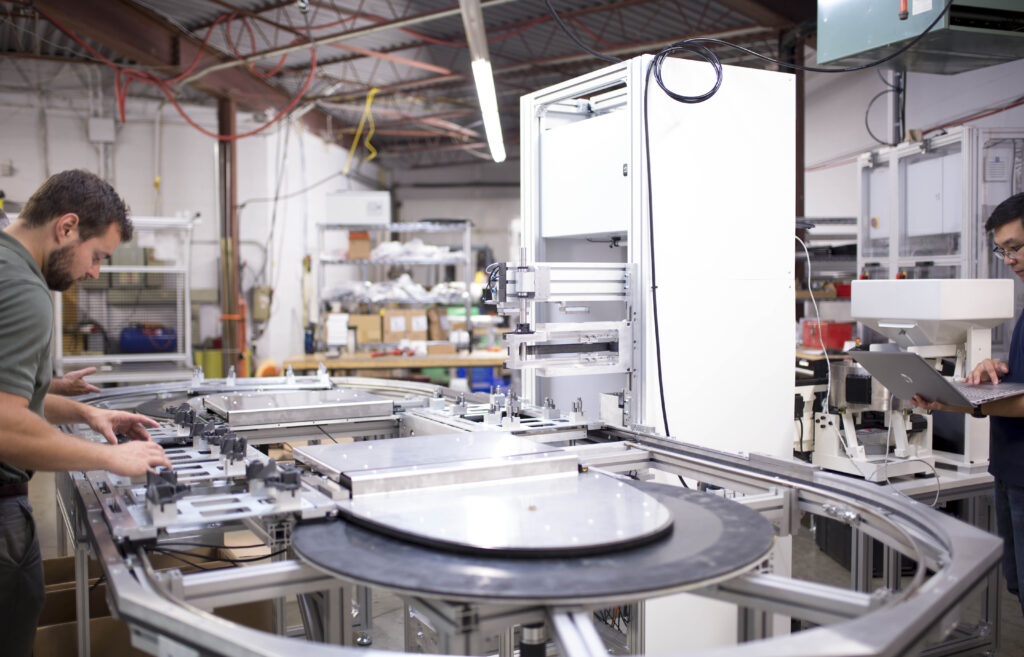
That was the first step for establishing Konnexio, a London, Ontario‑based automation company taking a fresh approach to machine design. Its flagship product, Adapto, replaces the traditional 10‑metre linear line with a network of smaller, self‑contained process cells that link together seamlessly.
Operators use a simple touchscreen interface to define motion paths avoiding the need for high‑end programmers or complex code. The result is a platform that can be customized for different products while keeping implementation times short.
Instead of a single machine performing every step, Adapto divides production into modular units, each with its own motion control built in. Modern communication protocols keep the cells synchronized, enabling a two‑second cycle time, which is still faster than most North American systems, that typically run at 10 seconds per cycle, but programmable, upgradeable, and far easier to maintain.
“The goal was to be the most adaptable,” says Konnerth. “We wanted a system you could reconfigure quickly, scale easily, and service without tearing it apart.”
AI and continuous improvement
Artificial intelligence now plays a growing role in fine‑tuning Konnexio’s systems. From optimizing drive acceleration to vision‑based quality control, AI tools help balance performance and yield in real time.
In one hydrogen fuel‑cell application, delicate materials demanded near‑perfect precision. “AI helps us dial balance between quality and throughput,” says Konnerth. “It learns, feeds back, and helps us make the process better over time.”
Growing from Southwestern Ontario’s talent
Canada’s thriving engineering ecosystem has enabled Konnexio to progress and scale into a company that pioneers innovation in automation and manufacturing. “The quality of people here is exceptional,” he says. “Southwestern Ontario has so many automation firms with worldwide success because of the skill and creativity in this region.”
Collaborating regularly with Western University and Fanshawe College, Konnexio often works with these educational institutions to combine fundamental research with applied solutions. While Western supports longer‑horizon studies, Fanshawe’s applied researchers have contributed directly to some of Konnexio’s navigation and robotics projects.
Together, they’ve helped the venture advance another innovation, AgriTrax, a greenhouse and field robotics platform designed for crop management and precision farming. AgriTrax grew out of earlier partnerships in ag‑robotics, including work with local mushroom harvesting automation. The current version, now in advanced prototyping, includes a robot that operates in strawberry fields, tending to plants and performing repetitive tasks autonomously. After initial success, the venture is now looking to refine its intellectual property strategy before full commercialization.
The road ahead
After more than two decades in automation, Konnerth is pragmatic about growth. The manufacturing slowdown has made capital projects challengin to close, but Konnexio continues to invest in product development, local partnerships, and export opportunities.
What helps him and the team at Konnexio cross that bridge is the presence of economic development organizations and innovation centres like TechAlliance of Southwestern Ontario, who he has been involved with for over twenty years. From being a Board Member and Board Chair to now passing the baton, Konnerth consulted with TechAlliance through different stages of his venture. “Whenever I need direction, be it funding, marketing, IP, there’s always someone here who can point me the right way or whom I can bounce ideas with,” he says.
With Adapto setting new benchmarks in modular automation, Konnexio is charting a distinctly Canadian path forward, where ingenuity, flexibility, and patience converge. By rethinking how machines are built and how talent collaborates across industry and academia, Konnerth’s team is proving that the future of manufacturing is about designing systems agile enough to grow and adapt with the world around them.